CCTV & Solar Camera Installation
CCTV and solar camera installation provides a practical way to monitor homes, businesses, warehouses, farms, offices, and other properties. A properly planned installation is important for achieving clear video coverage, reliable recording, stable connectivity, and long-term operation.
CCTV Installation Planning
Before installing any camera, inspect the property and identify the areas that require monitoring. Consider entrances, gates, parking areas, corridors, storage spaces, reception areas, and other important locations.
Camera placement should provide a clear view without unnecessary obstructions. Avoid positioning cameras directly toward strong light sources, as this can affect image quality.
The installation plan should also consider:
- Camera viewing angle
- Required image resolution
- Night-time visibility
- Recording requirements
- Cable routes
- Power availability
- Network connectivity
- Equipment protection
- Maintenance access
Camera Mounting
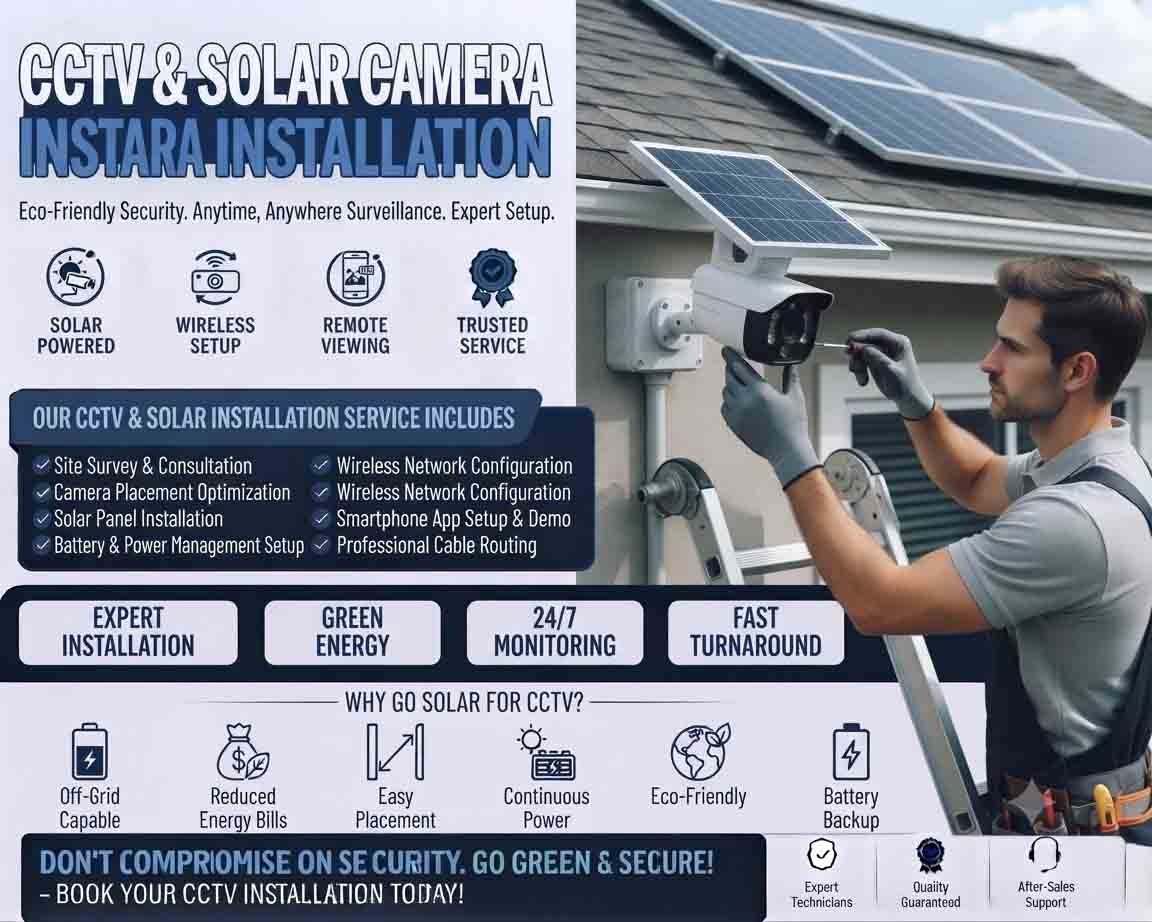
Cameras should be securely mounted on suitable walls, ceilings, poles, or other structures. The mounting surface needs to support the equipment and withstand normal environmental conditions.
After mounting, adjust the camera angle carefully to cover the required area. Avoid positioning the camera so that nearby walls, branches, signs, or other objects block the view.
Outdoor cameras should have appropriate weather protection for the installation environment.
Cabling and Power
For wired CCTV systems, cables should be routed safely and protected from unnecessary physical damage. Connections should be properly secured and protected from moisture where required.
Depending on the system, cameras may receive power through separate power cables or through Power over Ethernet (PoE).
Before completing the installation, verify that each camera receives stable power and communicates correctly with the recording equipment.
DVR and NVR Setup
A DVR or NVR can be used to manage and record camera footage, depending on the type of CCTV system.
During installation, configure the recorder and confirm that every connected camera is detected. Set the correct date and time, recording schedule, storage settings, and user-access permissions.
The system should then be tested to ensure that recorded footage can be retrieved successfully.
Solar Camera Installation
Solar cameras are particularly useful in locations where conventional electrical power is difficult or expensive to provide. They typically combine a camera, rechargeable battery, solar panel, and wireless or cellular connectivity.
When installing a solar camera, the solar panel should be positioned where it can receive sufficient sunlight throughout the day. Avoid placing it where buildings, trees, walls, or other objects create significant shade.
The panel angle and orientation should be selected according to the location and seasonal sunlight conditions.
Solar Camera Battery and Power Check
The battery is an important part of a solar camera system because it powers the camera when sunlight is unavailable.
Before installation, check the battery condition and confirm that the solar panel is charging the battery correctly. Camera recording frequency, motion detection, night vision, and communication settings can all affect energy consumption.
A camera that uses more power than the solar system can replenish may eventually stop operating.
Wireless and Remote Connectivity
Many modern solar cameras use Wi-Fi or cellular networks for remote access. Test the signal strength at the intended installation location before permanently mounting the equipment.
Verify that the camera can transmit video and that authorized users can access live viewing and recorded footage.
If the signal is weak, repositioning the camera or using an appropriate network solution may improve reliability.
Night Vision Testing
Night-time testing is essential for outdoor surveillance. Check whether the camera provides sufficient visibility after dark and whether infrared illumination is functioning correctly.
Pay attention to reflections from nearby walls, glass, vehicles, or other surfaces, as these can reduce night-time image quality.
Final Installation Inspection
After installation, test every camera individually. Confirm:
- Live video is working
- Recording is functioning
- Date and time are correct
- Night vision works properly
- Motion detection operates as expected
- Remote viewing is available when required
- Solar charging is functioning
- Battery status is healthy
- Camera mounting is secure
- Cables and connections are protected
A well-planned CCTV and solar camera installation provides dependable surveillance while reducing future maintenance problems. Proper camera positioning, secure mounting, reliable power, adequate network connectivity, and thorough testing are the key elements of a successful installation.










Reviews
There are no reviews yet.